Web Video Viewers OK With More Ads

adweek/photos/stylus/79421-OnlineL.jpg

Hulu is leaving some serious money on the table.

While its parent companies NBC Universal, News Corp. and Disney wrestle with the possibility of imposing a subscription fee on Hulu to offset what they perceive as lost ad revenue from TV, they might be better off simply dialing up the number of ads that run on the site, according to comScore.

The Web researcher released new research today at the Advertising Research Foundation’s annual convention and expo in New York which found that people who watch TV shows on the Web are far more tolerant of ads than perhaps once thought, and would actually stand for more clutter. Specifically, comScore found that while sites like Hulu typically serve around four minutes of ads for every hour of content, users would be OK with six to seven minutes of ads.
Continue reading

Break Media Sees Data as Display’s Savior

Male-centric Break Media is betting on data to enhance its display advertising business.

The company, which manages sites such as Break.com, MadeMan and Chickipedia, has inked separate pacts with BlueKai, which aggregates in-market shopper data for brands, publishers and ad networks, and eXelate, which manages an exchange for behavioral targeting data.

Break will leverage both companies’ data to offer its advertisers the ability to target more specific, narrow audiences — including audiences that are intent on shopping for or purchasing specific products.

“These partnerships, combined with the size of our network and the breadth of our ad offerings, will ensure that Break’s advertisers will be able to reach as much of their intended audience as possible, and do so with maximum efficiency and effectiveness,” said Andrew Budkofsky, Break’s evp of sales and partnerships.

With these deals, Break joins a growing number of online media companies turning to outside vendors that specialize in layering audience data on top of a site’s data with the promise of delivering the right ad to the right users. The approaches vary, as publishers experiment with blending offline shopping data, online cookie data and data from companies that claim to be able to find “look-alike” users based on modeling technology. For example, MTV Networks recently signed a deal with the analytics firm Quantcast to bolster its online video ad sales.

The Digital Exchange

If nothing else, SXSWi is a celebration of ideas. We share them, question them, challenge them and gather around them. Perhaps most importantly, we search for new ideas and try to imagine their consequences.

So it’s not entirely remarkable that Ben Malbon, executive director of innovation at BBH and managing partner and founder of BBH Labs, and his brother Tim, founder of London’s Made by Many, assembled 30 worldwide “competitors” to talk about how we might collaborate and innovate together in an effort to not only reinvent the future, but blow up the now.

via The Digital Exchange.

Engagement Is Key for Rich Media Video Ads

adweek/photos/stylus/108156-onlineL.jpg

When it comes to rich media ads on the Internet that employ video, engagement matters enormously. Environment, not so much.

That’s the major and in some ways surprising take-away from a new study conducted by VideoEgg and comScore.

The study examined the effectiveness of rich media video ads vs. traditional banners. The goal was to prove the theory that banner ads containing video are more engaging. In addition, the study gauged whether site environment — particularly contextual relevance — played a role in how well such ads performed. Continue reading

Macy’s, Sears Get Social for Prom Pushes

adweek/photos/stylus/130828-Macys.jpg

Two of the nation’s biggest department stores — Macy’s and Sears — are using social media to drive prom sales for the first time this year.

Sears this month launched the Ultimate Prom Experience, a microsite dedicated to helping teens find the perfect dress. The site, accessible at Sears.com/prom, includes features such as a “Find out your prom [dress] personality” quiz, hair and makeup tips, a list of the 10 hottest trends, and a $1,000 sweepstakes. Quiz takers may also share and post the results on Facebook or Twitter.

Continue reading

Microsoft Slams Google’s Ad Practices

adweek/photos/stylus/18054.jpg

Microsoft used a speaking slot provided by the Association of National Advertisers to open a broad assault on rival Google, accusing the Web giant of using its market clout to the detriment of advertisers.

Microsoft deputy general counsel Mary Snapp laid out her company’s case to advertisers gathered in Washington, D.C., today for the ANA Advertising Law & Public Policy Conference, which Microsoft sponsored. Ironically, Microsoft based its criticisms on Google’s size in the market, mirroring charges leveled against the software firm in the 1990s.

Continue reading

Why So Few TV Ads Are Viral Hits

adweek/photos/stylus/114697-OnlineVideoL.jpg

The Holy Grail for many marketers is having their big-budget TV spot become a viral hit online, providing millions of dollars worth of free exposure from consumer pass-along.

The bad news is the chance of this happening is pretty slim, and even if it does, there’s a good chance the spot won’t do much to persuade viewers.

Those are the conclusions of a Millward Brown study of TV commercials posted online. The researcher found that less than 15 percent of 102 ads studied were viral hits. (Millward Brown defines a viral hit as a spot that generates more than 1,000 views per week in the United Kingdom market or 5,000 in the U.S.) In other words, for every Old Spice “The man your man could smell like” spot that has generated more than 4.5 million YouTube views, there are five duds. Continue reading

Wendy’s Floods NCAA Social Media Zone

Wendy’s is attempting to insinuate itself into this year’s NCAA men’s basketball tournament with a social media push designed to create real-life parties.

The fast feeder has worked with The Kaplan Thaler Group for Facebook- and Twitter-based promos dangling gift cards for boneless wings to consumers who organize viewing parties using the social networks. The Facebook effort gives away $50 gift cards to 100 such consumers at random.

via Wendy’s Floods NCAA Social Media Zone.

A New Definition of Digital Magazines

The Audit Bureau of Circulations, anticipating the growth of e-reading devices like the Apple iPad, has expanded its definition of digital magazines to accommodate the shift.

The ABC originally defined a digital magazine as an exact replica of the printed version, and had in mind magazines delivered on PCs, not the forthcoming tablets with their wide range of interactive and multimedia capabilities.

via A New Definition of Digital Magazines.

Policing the Online Ad Market

The government may soon wield a great deal more power over the online advertising business, and that’s quickly spreading fear across the entire ecosystem, including publishers, ad networks, agencies and even their clients.

Rep. Rick Boucher (D-Va.) is set to introduce a consumer privacy bill over the next few weeks that will likely impact the entire $25 billion online ad market, according to sources.

via Policing the Online Ad Market.

Digital Gets Physical

In the great Facebook fan rush of 2009, Skittles stood out. The Wrigley brand was able to accumulate a staggering 3.6 million connections. This gave the brand an opportunity to message this audience — but not much more.

Last month, it decided to get real. Skittles kicked off “Mob the Rainbow,” a social media campaign that turns loose its virtual friends on the real world in service of fun challenges. To start, over 45,000 Skittles fans created Valentine’s Day cards for an unsuspecting traffic enforcement officer in San Francisco. Skittles filmed the encounter and posted it on Facebook, bringing the effort full circle from digital to physical back to digital. It led to another boost in Facebook fans, with nearly 500,000 added in a month.

via Digital Gets Physical.

Clients Say Shops Are Too ‘Reactive’

The complaints are all too familiar, but a new poll of client executives finds that agencies still aren’t proactive enough and need to make more of an effort to grasp the business challenges that clients face.

Asked to identify their top sources of frustration with agencies, the execs pointed to “more reactive than proactive” above all else, followed by “poor communication,” “not understanding our company’s business” and “insufficient creativity or originality.”

via Clients Say Shops Are Too ‘Reactive’.

More 3-D Ads Coming to Theaters Near You

More 3-D cinema ads are just around the corner.

Nearly 14,000 movie theaters operated by the three largest chains are set to install digital projection systems from Digital Cinema Implementation Partners, a joint venture of AMC Entertainment, Cinemark Holdings and Regal Entertainment Group. The three chains formed DCIP to deploy digital projection systems at movie theaters in the U.S. and Canada.

via More 3-D Ads Coming to Theaters Near You.

5 Digital Truisms for Marketers

Many marketers would be only too happy to forget 2009. Even though digital spending was not exempt from the suffering, testing and new approaches yielded big payoffs, which may be as hard to sustain in 2010 as our already-defunct New Year’s resolutions. As we dive into 2010, there are some key opportunities and risks in the digital landscape that will change the way we do business this year.

via 5 Digital Truisms for Marketers.

30 Web Trends to Watch in 2010 | SEOptimise

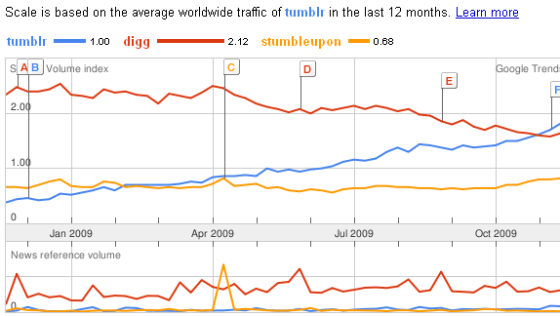
Google Trends for Tumblr, Digg and StumbleUpon

Last year I made about 30 predictions on Web trends for 2009. Many of them came true, others, of course, did not. Still even in those cases the ideas from the Web trends list were useful. Even those trends that disappeared from the radar or haven’t got main stream yet should be watched closely as they might pop up again sooner or later.

So I decided to make a new Web trends list, this time for 2010.

via 30 Web Trends to Watch in 2010 | SEOptimise.